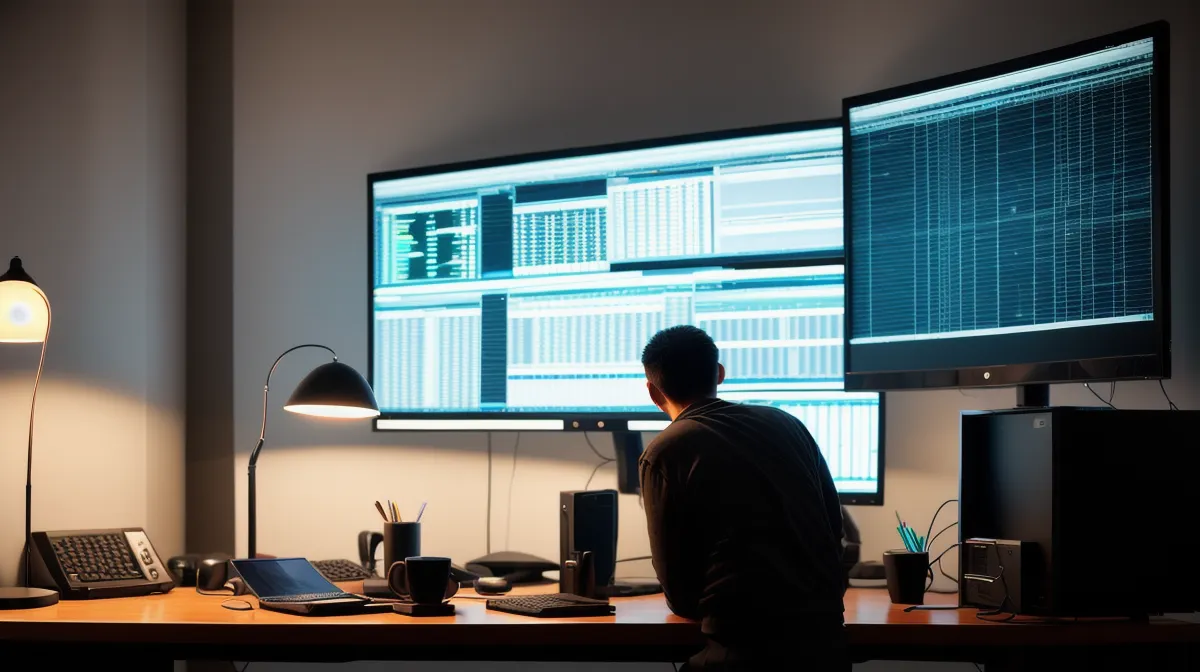
Late at night in my Charlotte home office, the blue light of my spreadsheet glows as I cross-reference the latest Powerball draw against my AI-generated predictions. The sharp click of my mechanical keyboard echoes in the quiet house as I input the Saturday night numbers while my coffee goes cold on the edge of the desk. My wife calls my master file 'the digital quilt,' and she isn’t entirely wrong—it is a patchwork of probabilities and historical frequencies that I’ve been obsessively stitching together since late last year.
Before we get into the weeds, a quick heads-up: I use affiliate links on this site. If you decide to try one of these tools through my links, I earn a commission at no extra cost to you. I only talk about the platforms I have actually plugged into my tracking sheets. Also, I’m a data analyst, not a financial advisor or a math wizard. I have zero professional gambling credentials. Lottery games are entertainment with a negative expected value, so treat them like a movie ticket, not a retirement plan. If you find yourself spending more than you can afford, please talk to a professional counselor.
From Office Pools to Algorithmic Analysis
It started innocently enough with the $2 office pool at my firm. I got annoyed by the 'it is all just luck' narrative my coworkers pushed while they picked birthdays and anniversaries. As a numbers guy, I knew Powerball operates on a fixed set of mechanics: a white ball pool of 69 and a red ball pool of 26. While each draw is independent, the distribution of numbers over time creates data points that are just begging to be analyzed.
I moved from a basic Excel sheet to testing dedicated AI platforms in early spring to see if historical frequency actually correlates with future draws. Most of the advice you find online for these tools assumes you have a massive bankroll for high-volume plays—buying dozens of tickets to cover every 'hot' sequence. But that’s not realistic for most people, especially those in lower-income brackets who are looking for a smarter way to play a single ticket. My goal was to find a risk-averse, minimal-investment frequency model.

The Deep Dive with LottoChamp
After about four months of manual tracking, I integrated LottoChamp into my routine. I wanted to use its pattern detection to filter through decades of historical data that my manual sheet simply couldn't handle. State lotteries maintain public databases of every winning combination, but scraping that data manually is a nightmare. I actually spent three hours trying to manually scrape the North Carolina lottery website one Wednesday evening last month before realizing the AI tool had already updated its entire database automatically while I was still wrestling with Python libraries.
What I appreciate about LottoChamp is that it doesn't just spit out 'lucky numbers.' It provides a weight to different sequences based on frequency. It even offers a 60-day money-back guarantee, which is a nice safety net for those of us who are naturally skeptical. I’ve been using it to identify 'overdue' numbers—those that haven't appeared in the last 20 draws but have a high historical frequency in the overall 1-in-24.87 odds of winning any prize.
The Turning Point: Data Over Gut
One Tuesday evening last July, I had a moment of clarity. I had been stubbornly playing a specific 'cold' number sequence for weeks because I felt it was 'due.' The AI tool flagged this exact sequence as a low-probability outlier based on current variance trends. I had to stare at my screen and realize that my 'gut feeling' was just a cognitive bias. I forced myself to trust the data and swap the numbers.
I remember explaining this to a coworker over lunch. I told him I wasn’t 'gambling' in the traditional sense; I was performing a longitudinal study on algorithmic predictive accuracy. He just blinked at me, looking confused, and went back to his sandwich. To him, it's a scratch-off; to me, it's a data set. I often find myself thinking 'variance is just a lack of data' while staring at the heat maps of frequency distributions on my monitor.

Comparing the Alternatives
While LottoChamp is my primary tool, I’ve looked at others to see how they stack up. For instance, Lottery Defeated offers similar frequency analysis but feels a bit more geared toward those who play multiple different games across state lines. It’s a bit more expensive, which might not fit the 'minimal investment' model I’m trying to perfect.
Then there is Lotto Master Key. It’s a simpler system, and while its technical specs show a 1.66% conversion rate in the markets I track, it lacks the deep historical weightings I prefer. However, if you’re looking for something less overwhelming than a full AI suite, it’s a solid entry point for a budget-conscious player.
For more on how I set up my tracking, you might want to read about the spreadsheet that annoyed my wife or my master spreadsheet audit of AI lottery predictions.
Final Reflections: Assistants, Not Oracles
Ten months into this experiment, I’ve learned that these tools are best viewed as data-filtering assistants rather than 'guaranteed' systems. They help you eliminate the 'junk' numbers that mathematically have a lower probability of appearing in the next draw. For someone trying to be risk-averse, this is the real value—making every dollar spent on a ticket work slightly harder by aligning it with historical trends.

The process of analysis is, honestly, more rewarding than the gamble itself. There is a certain satisfaction in seeing a 'cold' number you flagged eventually pop up exactly when the model predicted its frequency would spike. If you're tired of the randomness and want to see how the patterns actually look, I'd suggest starting with a tool like LottoChamp to see the data for yourself. Just remember: keep the coffee hot, the spreadsheet organized, and the expectations realistic. It's a long game, and the data is the only thing that doesn't lie.
The information on this site is based on personal experience and research for informational purposes only. It is not a substitute for professional medical, financial, or legal advice. Always consult a qualified professional before making decisions that affect your health or finances.